Learn Gomoku & Renju
Gomoku vs Renju: What Is the Difference?
If you learned five-in-a-row from a friend or a phone game, you learned Gomoku. If you later lost a game because someone said "that's a forbidden move", you met Renju. Same board, same stones, same goal, and that one phrase is the whole difference.
We run Omok Code, an online Gomoku app that plays by Renju rules, and the question new players ask us most often is exactly this one: why is my winning move illegal? This article is our answer.
Where the two games agree
Both games are played on the intersections of a grid with black and white stones. Black moves first, stones never move once placed, and you win by lining up five of your colour in a straight line, horizontally, vertically or diagonally. Renju is always played on 15×15. Gomoku is usually 15×15 as well, though people happily play it on a 19×19 Go board.
In casual Gomoku a line of five or more wins, and that is the end of the rulebook. (Some variants, sometimes called "standard Gomoku", only count exactly five.) Nothing restrains the first player, and that is the problem.
The problem Renju solves
Gomoku is a race, and the player who starts the race is ahead. This is not a feeling. Computer searches in the 1990s and 2000s proved that with perfect play the first player wins Gomoku, both the five-or-more version and the exactly-five version. Between strong humans you see the same thing: Black attacks, White blocks, and if Black knows the theory, White never gets a turn to breathe.
Renju's fix is unusual. Instead of giving White something, it takes things away from Black.
Three moves Black may not play
In Renju, a single black stone may not create any of the following. If it does, Black loses on the spot. White has no such limits, and a white line of six or more simply counts as a win.
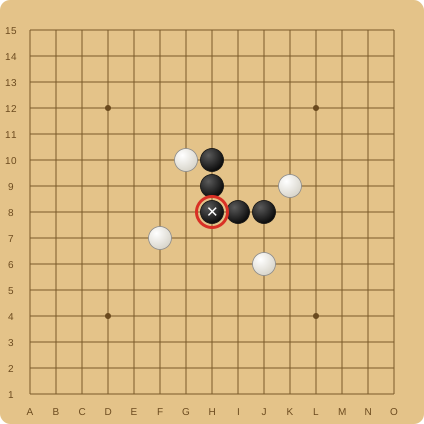
Double three (3-3)
One move that makes two open threes at once. An open three is a three that can become an open four, a four with both ends empty, on the next move. Split threes like ●●_● count as well.
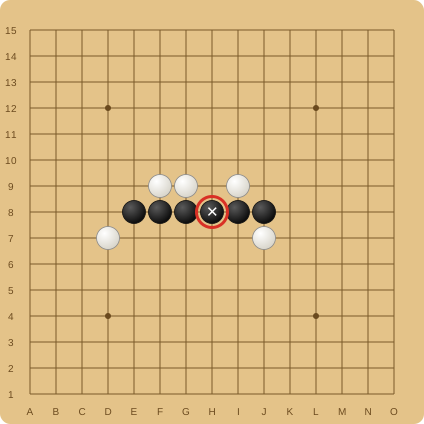
Double four (4-4)
One move that makes two fours at once. It does not matter whether the fours are blocked at one end, and the two fours may even lie on the same line, as in ●●●_●●●, where the empty point completes a four in each direction.
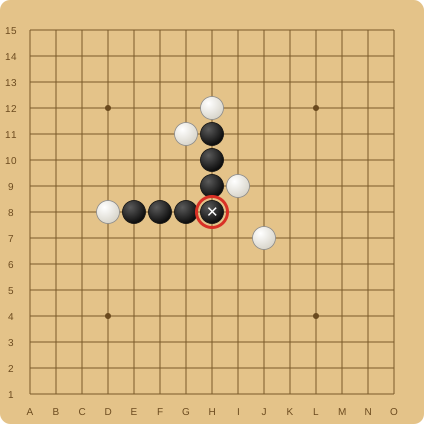
Overline
Six or more in a row. For Black it is a forbidden move; for White it is a win.
One exception matters: if a move makes a five and a forbidden shape at the same time, the five counts. Five always comes first.
Why Black and White play two different games
This is the part newcomers rarely hear about, and it is the reason people get hooked on Renju.
Black plays an attacking game across a field of landmines. Black's basic winning weapon is the four-three: one stone that makes a four and an open three together. White has to answer the four, and the three then grows into an open four that nothing can stop. So Black spends the whole game steering towards a four-three while stepping around every point that would make a double three, a double four or an overline. Very often the most natural attacking point is exactly the forbidden one, and Black has to find a detour, or change the shape first so that the point stops being forbidden. Black's question is never just "does this win?" It is "does this win, is it legal, and will the next point still be legal?"
White plays defence with a knife behind its back. White's first job is the one you expect: block fours, break open threes, counterattack when Black overreaches. But White has a weapon that does not exist in Gomoku: Black's forbidden points. A point Black can never occupy is, for White, a free wall. White can build around it, lean on it, and best of all, drive Black into it. The classic finish is a four, or a chain of fours, where the only point that blocks White's line is a double-three or double-four point for Black. Black either lets the five happen or plays the forbidden move and loses. Either way the game is over, and White has won it not by out-racing Black but by turning Black's own rules against Black.
Watching a good White player set that trap three moves ahead, while Black still believes the attack is going well, is one of the most satisfying things in the game. It is also why experienced players do not mind drawing White in Renju. In Gomoku, White is the side that hopes Black slips. In Renju, White has a plan of its own.
Opening rules
Even with the forbidden moves, Black is still favoured if Black chooses the opening freely, so competitive Renju adds an opening procedure. This is the second big difference from Gomoku.
The classic international rule fixes the first three moves: Black in the centre, White next to it, Black inside the central 5×5 area, which gives 26 standard openings. White may then swap colours, and Black has to offer two candidate fifth moves for White to choose from. The swap means Black cannot simply pick a favourite opening and run with it.
Modern tournaments use newer procedures, mainly Soosõrv-8 and Taraguchi-10. In Taraguchi-10 the first four moves are placed inside expanding areas, and after each of them the opponent may swap colours. After the fourth move, Black either plays the fifth move directly, which lets White swap once more, or offers ten candidate fifth moves anywhere on the board and White picks one. The result is an opening that is close to even, which is what lets Renju work as a serious competitive game.
Side by side
| Gomoku (free-style) | Renju | |
|---|---|---|
| Board | 15×15 or 19×19 | 15×15 |
| Win | Five or more in a row (some rules: exactly five) | Exactly five for Black; five or more for White |
| Restrictions for Black | None | No 3-3, no 4-4, no overline (a forbidden move loses) |
| Restrictions for White | None | None |
| How White wins | Outlast Black's attack | Block, counterattack, or walk Black into a forbidden point |
| Opening | Free | Fixed first moves, swap options, alternative fifth moves (Soosõrv-8, Taraguchi-10) |
| Balance with perfect play | First player wins | Close to even |
| Where it is played | Casual games, many apps | Tournaments, the World Championship, rating systems |
Which one should you learn?
For a quick game with friends, Gomoku is fine: one sentence of rules, and whoever holds Black is a little lucky. Plenty of regional games sit between the two. Korean omok is often played with the 3-3 forbidden for both players, and Vietnamese caro counts only an exactly-five line whose two ends are not both blocked.
If you want to get better, play rated games, or study openings and problems, learn Renju. Almost everything written about the game, from opening theory to published problems, assumes Renju rules, and the forbidden moves are precisely what give the game its depth. And once you have won a game as White by walking Black into a forbidden point, you will not want to go back.
A note on names
Gomoku (五目) is Japanese for "five points"; omok (오목) is the Korean reading of the same characters; Renju (連珠), "connected pearls", is the name chosen in Japan in 1899 for the regulated game. "Five in a Row", "Gobang" and "Caro" all belong to the same family.
Playing Renju online
Omok Code plays by Renju rules. Forbidden points are checked automatically, so you learn them by seeing them rather than by losing to them, and ranked games between higher-ranked players use Taraguchi-10, the same opening procedure as international tournaments. You can play other people, practise against AI opponents from beginner to master, and after each game an AI analysis points out the wins you missed and the moves that let the other side set a trap. It runs in the browser with no sign-up, and there are Android and iOS apps too.