Learn Gomoku & Renju
Gomoku vs Chess vs Go: Three Games, Three Ways of Thinking
If you come to Gomoku from chess or Go, your first real loss usually looks the same. You have built a sensible position and kept your options open, the way the other games taught you. Then your opponent plays a four. You block. Another four. You block. A four and a three at once, and the game is over. You were playing a positional game. Your opponent was reading.
We run Omok Code, an online Gomoku app, and many of our players arrive from chess or Go. This article is about what surprises them. A note on words: by Renju we mean Gomoku as it is played in tournaments, where Black has forbidden moves and the opening follows the Taraguchi-10 rule.
The short version. All three games start with memorised openings. After that, chess and Go are mostly decided by positional judgement, a trained sense of shape and balance that research has shown to be largely pattern recognition built from experience. Gomoku needs that sense too, but it is not what wins. Every four and every open three is a forcing move, so the middle game is a hunt for a forced sequence, and the player who reads it exactly, to the end, wins.
The opening: everyone memorises
Chess players call it "book", and strong players prepare lines twenty moves deep before a tournament. Go has joseki, corner sequences refined over centuries, and fuseki, whole-board opening patterns. Renju is no different. Taraguchi-10 has the players place the first stones one at a time, with the right to swap colours after each, so that nobody can steer the game into a line they know by heart. Serious players still study those early positions in depth: which ones are balanced, when to swap, which fifth moves hold. Our article on Gomoku and Renju explains the rules.
So far the three games agree. The interesting question is what you do when the book runs out.
Chess and Go: the position speaks to the experienced
In the 1940s the Dutch psychologist Adriaan de Groot asked grandmasters and club players to think aloud over the same positions. The grandmasters did not calculate deeper or look at more moves. The right candidates simply came to them within seconds. Chase and Simon later traced this to tens of thousands of stored patterns, and Gobet and Simon noted that Garry Kasparov, playing several grandmasters at once with almost no time to calculate, performed only a little below his tournament strength.
Go leans on judgement even harder. There are about 250 legal moves at any moment, nothing to count, and no exact answer to "who is ahead". The clearest evidence came from AlphaGo. In the 2016 Nature paper its policy network, which proposes moves from the pattern on the board with no lookahead at all, beat a search program of amateur 2-dan strength in 85% of their games. A network that only looks, and never reads, plays dan-level Go.
Both games have calculation, of course. Chess tactics and Go life-and-death problems are pure reading. But those moments are the exception. Most moves are played in positions where nothing is forced, and the guide is judgement built from thousands of games.
Gomoku: the rules force the game into lines
In Gomoku a four has to be blocked at once, or the game ends on the next move. An open three has to be answered at once too, because an open four cannot be blocked. So when the attacker plays a threat, the defender's reply is dictated: one possible answer to a four, two or three to an open three. The attacker can chain threats, and while the chain lasts the defender has no choices. Players call these chains VCF, victory by continuous fours, and VCT, victory by continuous threats.
That changes the shape of the game. In chess or Go a typical position offers dozens of reasonable moves, and no way to prove which one is best. In Gomoku, once the threats start, the tree narrows to a single line that can be followed to its end. It is not a bush. It is a thin stick, and a thin stick can be read.
For a human player the consequence is simple to state. In a Gomoku middle game the real question is binary: is there a forced win here, or not yet? There is no material to be up and no territory to count. You find the four, the forced block, the next four, the four-three at the end, and you check every step before playing the first. If one branch fails, the attack fails, and every threat you played has handed your opponent a stone. In chess a miscalculated combination costs a pawn. In Gomoku it usually costs the game.
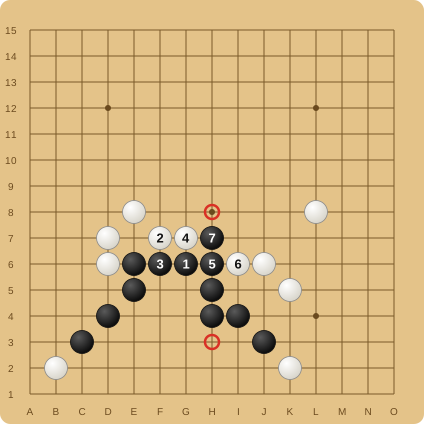
Black to play and win. Every White reply is forced: 1 and 3 make fours, 5 makes a four and an open three together, and 7 is an open four that cannot be stopped (the marked points). A strong player sees move 7 before playing move 1.
Where intuition still matters
Before anyone has a forcing sequence, the game is about shape: placing stones so that they work along several lines at once, and keeping threats in reserve. Experienced players feel where the potential is, and the same feeling tells them which line to read first. But in Gomoku intuition proposes and reading disposes. In chess or Go you can win a game on judgement alone. In Gomoku a player who never reads to the end loses to the first opponent who does.
Side by side
| Chess | Go | Gomoku / Renju | |
|---|---|---|---|
| What you memorise | Opening lines | Joseki and fuseki | Opening positions and fifth moves |
| What decides the middle game | Positional judgement, tactics when the position allows | Whole-board judgement, reading in local fights | Reading forcing sequences |
| A typical blunder | Losing material | Losing a group, or the direction of play | Missing a forced win, or walking into one |
| How players train | Tactics, openings, endgames | Life-and-death problems, professional games | VCF and VCT problems, finding the win that was missed |
If you come from chess or Go
Chess players adapt fastest, because they already know forcing lines. What they have to unlearn is the quiet waiting move. Go players bring the reading habit from life-and-death problems. What transfers less is the whole-board view, because in Gomoku only the lines matter. Either way the training is the same: solve VCF and VCT problems, and after each game find the sequence you missed.
Omok Code is built around that. It plays by Renju rules, with Taraguchi-10 openings in higher-ranked games, and after every game an AI analysis marks the moves where a forced win was on the board, the moves where you let one slip, and the rare brilliant move that found a win nobody expected. It runs in the browser with no sign-up, and there are Android and iOS apps too.
Sources
- Adriaan de Groot, Thought and Choice in Chess (1946; English edition 1965). Overview on Wikipedia.
- William G. Chase and Herbert A. Simon, "Perception in chess", Cognitive Psychology 4 (1973). Publisher page.
- Fernand Gobet and Herbert A. Simon, "The roles of recognition processes and look-ahead search in time-constrained expert problem solving", Psychological Science 7 (1996). Repository record.
- David Silver et al., "Mastering the game of Go with deep neural networks and tree search", Nature 529 (2016). Article.